Range Repair
Viking Range Burner Clicks But Will Not Light
Written by Ambrose Fitzwilliam Service technician — refrigeration and sealed systems · 25 years in the trade
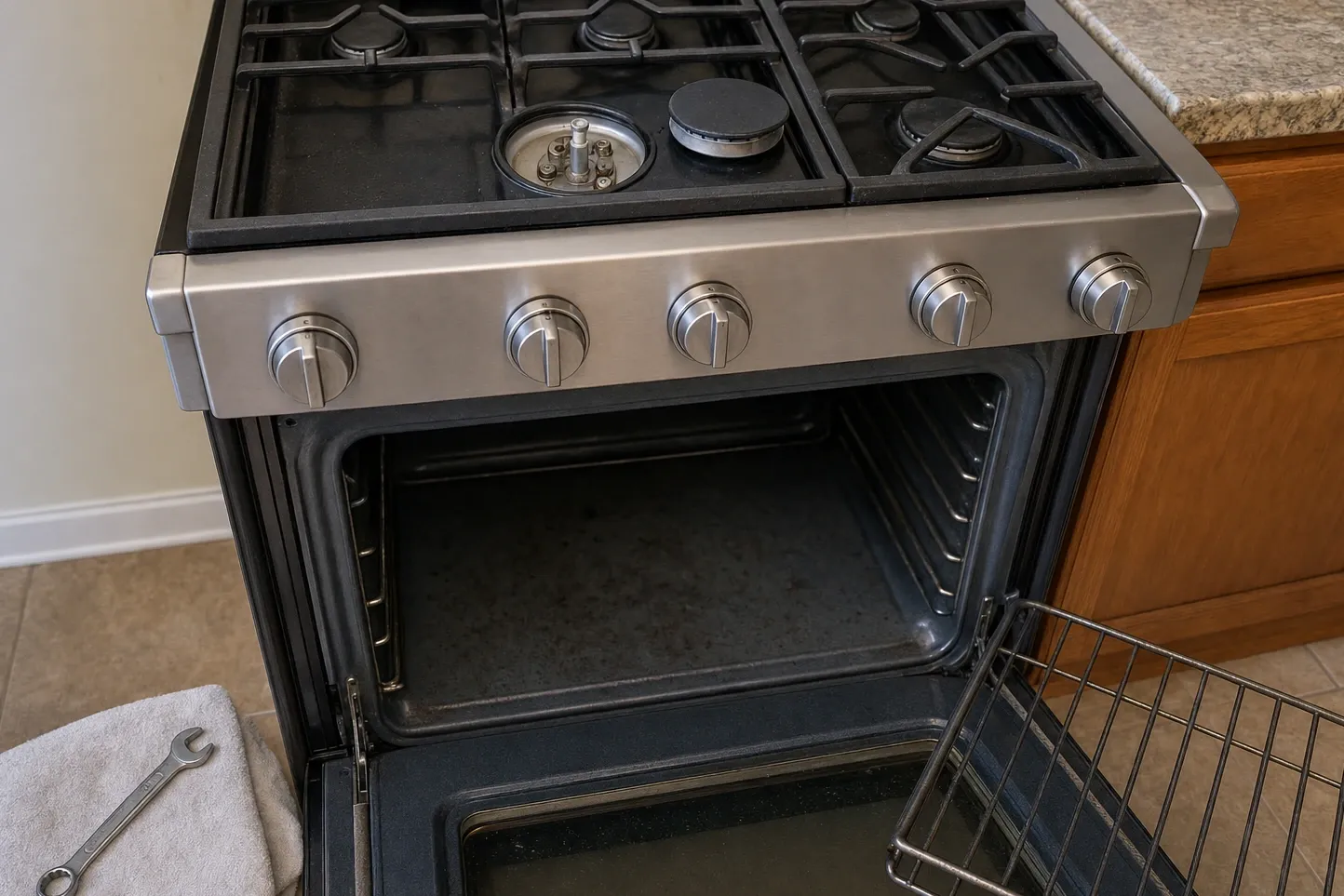
A Viking burner that clicks and clicks and then finally catches when you hold a match to it is one of the most common calls this shop takes, and it is also the one most often misdiagnosed — usually as a dead igniter, which it hardly ever is. The clicking is the proof that the ignition system is alive. What the burner is telling you is that the spark and the gas are not meeting.
What the clicking actually means
On a Viking professional range the burners are lit by a spark, not by a standing pilot. Turn the knob to light and the switch behind it closes, a module starts firing high voltage at every electrode on the rail, and the valve opens to let gas out of the burner ports. The click you hear is that spark jumping the gap between the electrode tip and the burner head.
Two things follow from that. First, if you can hear clicking, the module, the switch and the wiring to that electrode are all doing their job — so an igniter replacement is very often money spent on a working part. Second, on most Viking tops all of the electrodes fire together whenever any burner is turned to light, which is why the whole cooktop ticks when you light one ring. That is designed behavior, not a fault.
The fault is in the meeting. Either the spark is landing somewhere it cannot ignite anything, or the gas is not arriving at the electrode in a mixture that will catch.
The three faults behind it, in the order they turn up
A blocked or wet burner port. This is first because it is the most common and because it is free to fix. Cooking spillover bakes onto the ports around the crown, and after a kitchen remodel — very common in Toluca Lake, where a wide range usually goes in as part of the work — fine drywall dust packs the ports and the air shutter underneath. Gas then leaves the burner in the wrong place or too lean a mixture, and the electrode has nothing to ignite. If one specific burner is slow to catch and the rest are instant, this is your suspect.
A cracked spark module or a failing electrode. A module that has taken years of grease and heat can develop a hairline crack in its case. It still fires, so the clicking continues, but the voltage it delivers has dropped and the spark is weak, short and yellow-white instead of a sharp blue snap. Look at the spark in a dark kitchen: a healthy one is a tight, bright, audible crack across a small gap. A weak one looks lazy and sometimes flickers. The electrode itself can also crack its ceramic insulator, at which point the spark leaks into the burner base instead of jumping the gap.
A gas delivery problem. If the burner lights immediately from a match but never from its own spark, and the ports are clean, then the mixture arriving at the electrode is wrong rather than absent. That points at the air shutter setting or the orifice — and it is worth saying that a range converted from natural gas to propane, or moved from one house to another, can be running on the wrong orifice entirely. Yellow, sooty flames alongside slow lighting is the giveaway.
What is worth checking yourself
Turn the burner off first and let everything cool. Then, in this order:
- Lift the grate, cap and head off and look at the ports. They should be open slots, not filled craters. A stiff brush and a paperclip clear them; do not use anything that will widen a port.
- Look at the electrode. It sits at the edge of the burner base, a small ceramic post with a metal tip. Wipe it dry with a cloth. A soaked electrode after a boil-over or a heavy clean will click without sparking properly until it dries out, which can take a day.
- Check the head is seated. A burner head dropped back on at a slight angle puts the port furthest from the electrode, and the burner will act faulty when nothing is broken.
- Compare burners. Time how long each one takes to catch. One slow burner is a burner problem. All of them slow is a module or a supply problem, and that changes the conversation entirely.
What is not worth doing is buying an igniter kit online. On these ranges the electrode, the module and the harness are separate parts, and picking the wrong one is the usual outcome of guessing from a symptom.
When it becomes a call
Call someone when the clicking is continuous after the burner has lit, when every burner has gone slow at once, when you can smell gas at any point, or when the ports and the electrode are clean and it still will not catch. All three of those are past the point where a homeowner can safely narrow it further.
It is also a call if the range is clicking with no knob turned at all. That means a switch is stuck closed and the rail is energised permanently — an easy repair, but not one to live with, because it is sparking above a gas manifold every second of the day.
The $89 buys the visit and the whole diagnosis: the burner comes apart, the spark gets looked at rather than assumed, and you hear which part it is and what it costs to put right before anything is fitted. On a fault like this the answer is very often half an hour with a brush and a correctly seated head, and that is a much better outcome than a new module you did not need.
Follow-ups
Is it safe to keep using the burner if it lights off a match?
For one meal, with the window open, yes — but only if it lights promptly once you put the flame to it and then burns steadily. What you should not do is leave it clicking for thirty seconds at a time, several times a day. That is unburnt gas collecting under a cast grate before it finds an ignition source.
Why do all the burners click when I only turn one on?
That is normal on a shared spark rail. One module fires every electrode at once and whichever burner has gas flowing lights. It only becomes a fault when the clicking never stops after a burner has lit, which points at a switch that is not releasing.
Could it just be a dirty burner?
Often, yes, and it is the one cause worth ruling out before booking. Ports blocked with boil-over or drywall dust starve the flame path between the electrode and the gas, so the spark is fine and there is simply nothing near it to ignite.